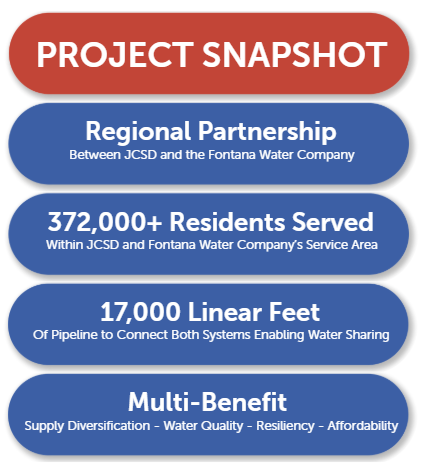
A shovel-ready regional interconnection led by JCSD in partnership with Fontana Water Company to diversify supplies, improve water quality, and strengthen long-term reliability and affordability for the Inland Empire.
A regional solution for safe, reliable, affordable water
Jurupa Community Services District (JCSD), in partnership with Fontana Water Company, is advancing a regional pipeline and water quality project that will connect systems and create a practical pathway for critical water sharing. This JCSD Intervalley Water Quality & Resiliency Project is a cornerstone investment to diversify JCSD’s water portfolio, reduce reliance on costly treatment of lower-quality groundwater, and strengthen reliability during droughts and emergencies.
JCSD is currently 100% dependent on local groundwater. Our sole source of water supply has been greatly impacted by contaminants such as per- and polyfluoroalkyl substances (PFAS). Addressing PFAS contamination requires advanced and costly treatment infrastructure, placing increasing financial pressure on ratepayers. By strategically connecting systems, this project reduces overreliance on impacted groundwater, improves supply flexibility, strengthens drought resiliency, and helps mitigate the long-term financial impacts associated with treating emerging contaminants.

100% Groundwater Dependency
JCSD relies entirely on local groundwater, limiting flexibility during disruptions and making diversification essential.

Water Quality Pressures
Groundwater contamination, including PFAS, requires costly advanced treatment, increasing long-term financial pressure on ratepayers.

Drought & Supply Volatility
A connected regional network strengthens reliability during drought, heat events, and supply disruptions.
Infrastructure Efficiency
These types of connections reduce duplicative investments by enabling shared resources and operational flexibility.
Project Scope and Components
Phase 1 — System Interconnection Pipeline (Shovel Ready)
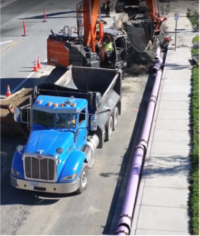
- Construct 17,000 linear feet of pipeline in a single phase
- Create an interconnection between JCSD and Fontana Water Company
- Enable access to surplus water and operational flexibility
- Built to support future regional water contributions (e.g., IEUA, Ontario, CVWD) as feasible
- Phase 1 cost: $60 million
Future Phases — High-Quality Supply Development in Fontana
- Develop two potable wells in Fontana where water quality is excellent
- Target production: 2,500+ gallons per minute per well
- Well siting supported by geoscience/technical studies
- CEQA complete for future well development components
- Includes land acquisition needs for well sites and supporting facilities
Status and Schedule

Current Status
- Partner coordination underway (JCSD + Fontana Water Company)
- Technical studies completed for future well development
- CEQA complete for future well components
2026
- Anticipated construction start (Phase 1)
-
Mobilization and early pipeline construction activities.
2026–2028
- Phase 1 pipeline construction
-
Single-phase build of the 17,000 LF intertie connection.
2028–2030
- Future wells (planned)
-
Two high-quality wells in Fontana (2,500+ GPM combined), contingent on funding and land acquisition.
Investment and Funding Opportunity
Strategic state and federal partnership can accelerate delivery and reduce local ratepayer burden.
$60,000,000
Phase 1 total project cost (pipeline connection)
The Intervalley Water Quality & Resiliency Project aligns with statewide water reliability priorities and has advanced through environmental review, including CEQA compliance. The project has secured approximately low-interest State Revolving Fund (SRF) financing, with up to $25 million in debt forgiveness. JCSD has also been awarded $3 million in grant funding from the Santa Ana Watershed Project Authority. Combined, these funding sources demonstrate early investment and regional commitment; however, additional partnership support is needed to fully deliver this shovel-ready infrastructure.
Partnership funding will accelerate construction, strengthen regional water security, and help protect long-term affordability for the Inland Empire. This investment supports a practical, collaborative approach to water management – connecting systems so agencies can share resources and respond to disruptions more effectively.